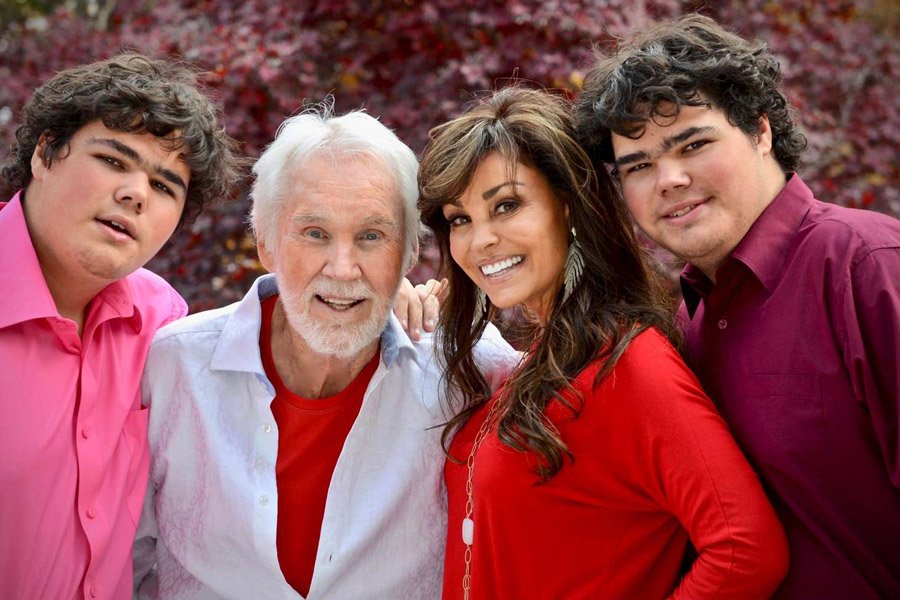
A name carried softly
Jordan Edward Rogers belongs to a family name that many people recognize before they know the person. That kind of inheritance can feel like a lantern held too close, bright enough to erase the outline of the person carrying it. Yet Jordan’s story is not one of constant display. It is a story of restraint, family memory, and a life that appears to have been built around ordinary days rather than public performance.
What makes his path interesting is not noise but contrast. His father lived in the sweep of arenas, radio waves, and popular memory. Jordan, by contrast, seems to move through a quieter lane. The difference is striking. One life was built for the stage. The other appears to value the porch light, the kitchen table, and the small ceremonies that make a home feel permanent.
Childhood shaped by ritual
Some children grow up with calendars full of events. Others grow up with rhythms so familiar they become part of the weather. For Jordan Edward Rogers, family tradition seems to have mattered as much as achievement. The recurring “Super Saturdays” described in the family narrative suggest a childhood built on repetition, not extravagance. A breakfast stop, a car wash, a playful outing, and then the return home. Simple pieces, repeated often, can create something stronger than spectacle. They become a kind of family architecture.
That matters because repetition teaches belonging. It says the world is not only made of milestones and announcements. It is also made of habits. A weekly ritual becomes a bridge between generations. It is a way of saying that affection does not need to arrive in grand gestures to be real. For a child growing up in the long shadow of fame, that kind of consistency can act like a shoreline in rough water.
Jordan’s early years also appear to have been shaped by the presence of a father who made room for family late in life. That shift from public career to private devotion gives Jordan’s upbringing a particular texture. The image is not of a celebrity household constantly in motion, but of a family trying to preserve normalcy inside an unusual circumstance.
The pressure of a famous surname
A famous last name is a strange inheritance. It can open doors, but it can also attach assumptions before a person has spoken a word. People look for resemblance. They hunt for talent, style, and destiny. They compare, project, and simplify. For someone like Jordan Edward Rogers, the challenge is not only to be known, but to remain intact while being watched through the lens of someone else’s legacy.
That pressure often pushes children of public figures into one of two roles. Some step boldly into the family spotlight. Others pull back until their private life becomes a kind of protective shell. Jordan seems to fit the second pattern. His low profile suggests a deliberate choice, or at least a temperament that does not crave constant attention. That choice carries its own dignity. It is easier to perform identity than to protect it. Privacy can be its own form of strength.
In a culture that often treats visibility as proof of value, restraint can look almost radical. It asks for patience. It asks for curiosity without entitlement. It asks people to understand that a person can matter deeply without becoming a public character sketch.
Growing up after loss
The death of a parent changes the geometry of a family. The center shifts. Old habits become memories, and memories become responsibilities. For Jordan, the loss of Kenny Rogers was not just the passing of a global entertainer. It was the closing of a household era. Family traditions that had once been routine would now carry a different emotional weight. They would become a way of keeping a voice present after the voice itself had gone silent.
Families often preserve the dead through objects, stories, and repeated behaviors. A meal once shared becomes sacred because it was shared at all. A phrase repeated at the right moment can suddenly feel like a hand on the shoulder. In that sense, Jordan’s continuing connection to family rituals suggests more than nostalgia. It suggests maintenance. Memory is not passive. It must be tended like a garden or it grows wild and thin.
Young adulthood after loss also tends to sharpen identity. Some people become more guarded. Others become more appreciative of the ordinary. Jordan’s public image, as described, seems tied to the second response. He appears to have inherited a family culture that values warmth, humor, and grounded habits over performance.
Education and the blank spaces after graduation
There is something revealing about a person whose life after high school is not fully mapped out in public. In an age when social media often turns every transition into a broadcast, a blank space can feel almost refreshing. Jordan Edward Rogers graduated from high school, but the story does not rush to dress him in a career, a brand, or a public mission. That absence is part of the story.
A young adult does not need to announce a destiny at 21. Sometimes the most meaningful work happens offstage, where interests can be tested without the glare of expectation. The years after school can be a workshop rather than a parade. They are where a person learns whether a talent is a calling, whether a habit is a preference, and whether a family legacy should be carried forward or quietly set down.
This in-between period is often misunderstood. People hear uncertainty and assume drift. In reality, uncertainty can be a clearing. It creates room for intention. Jordan’s path, at least from the outside, suggests someone choosing pace over pressure. That is not a small thing. In a world that rewards speed, patience can be a form of discipline.
The meaning of privacy in public families
Privacy is often mistaken for emptiness. In truth, it can be full of substance. It can hold friendships, work, learning, and family ties that do not need a camera to be real. For Jordan Edward Rogers, privacy seems to function less like a wall and more like a garden fence. It protects what grows inside it. It keeps the wind from flattening everything before it matures.
Public families face a special challenge. Their private life becomes a shared curiosity, and that curiosity can become hunger. Every appearance gets read for clues. Every photo gets treated like evidence. But a person is not a clue board. He is not a puzzle built for strangers to solve. The less Jordan reveals, the more the emphasis shifts back to the one thing that matters most, the fact that he is a son, a brother, and a young man making a life on his own terms.
That kind of life can feel modest from the outside. It may even seem almost invisible. Yet invisibility is not the same as insignificance. Some lives are loud because they must be. Others are steady because they can be.
A legacy that does not need to shout
Jordan Edward Rogers stands at an unusual crossroads. On one side is the enduring cultural memory of a famous father. On the other is the quieter, less charted terrain of adulthood. The interesting part is not that he comes from legacy. It is that he does not seem to be consumed by it. He appears to be living with it, not inside it.
That distinction matters. Legacy can become a cage when it is treated like a script. It can also become a resource when it is treated like a foundation. Jordan’s story suggests the second possibility. He carries family history without being reduced to it. He seems to understand that inheritance is not only about money or name recognition. It is also about temperament, habits, and values. It is about what gets repeated when no one is watching.
In that sense, Jordan’s life reads like a quiet chord held beneath a louder song. Not the melody everyone notices first, but the note that gives the whole thing depth.
How To Investigate A Neighbourhood Before You Call It Home
Making Westfield Cleanup Less Chaotic With The Right Dumpster